
Last updated: October 2026
Both loans put a property up as security. Both come from the same banks and NBFCs. Half the people you ask will call either one a “mortgage loan.” So it is easy to assume they are interchangeable, and that assumption can cost you lakhs. The difference between home loan and loan against property comes down to one question: are you buying a house, or borrowing against one you already own? The interest rate, the loan amount, the tenure and the tax benefit all follow from that answer.
What Is the Difference Between Home Loan and Loan Against Property?
A home loan pays for a house you are buying, building or renovating, and that same house becomes the lender’s security. A loan against property (LAP) uses a property you already own as security, and you can spend the money on almost any legal need, from business expansion to a child’s education. Home loans are cheaper, run longer and come with tax breaks. A LAP gives you freedom of use, but you pay more for it.
How a Home Loan Works
You pick a flat, a builder floor or a plot you plan to build on. The bank checks its value and papers, funds a share of it, and you pay the rest as down payment. The money never touches your account. It goes straight to the builder or seller, in stages for under-construction projects.
Your income decides how much you get. Lenders look at take-home pay, existing EMIs and your CIBIL score, and most keep your total EMIs within 50 to 60% of monthly income. You can run your own numbers on our home loan eligibility page before you speak to a bank.

How a Loan Against Property Works
Here you already own the asset: a house, a shop, an office, sometimes a warehouse. You mortgage it to the lender, the lender values it at today’s market price, and you get a percentage of that value in your bank account. You keep living in the house or running the shop. The lender holds the original title papers until the last EMI is paid.
The property carries more weight here than your salary does, which is why self-employed borrowers and business owners use LAP so much. A trader whose income tax returns look thin on paper can still raise a sizeable amount if the shop or home is clean on title. Income still matters, though. The lender wants to see that the EMI is affordable, so a ₹1 crore flat does not automatically mean a ₹70 lakh loan.

Home Loan vs Loan Against Property: Side-by-Side
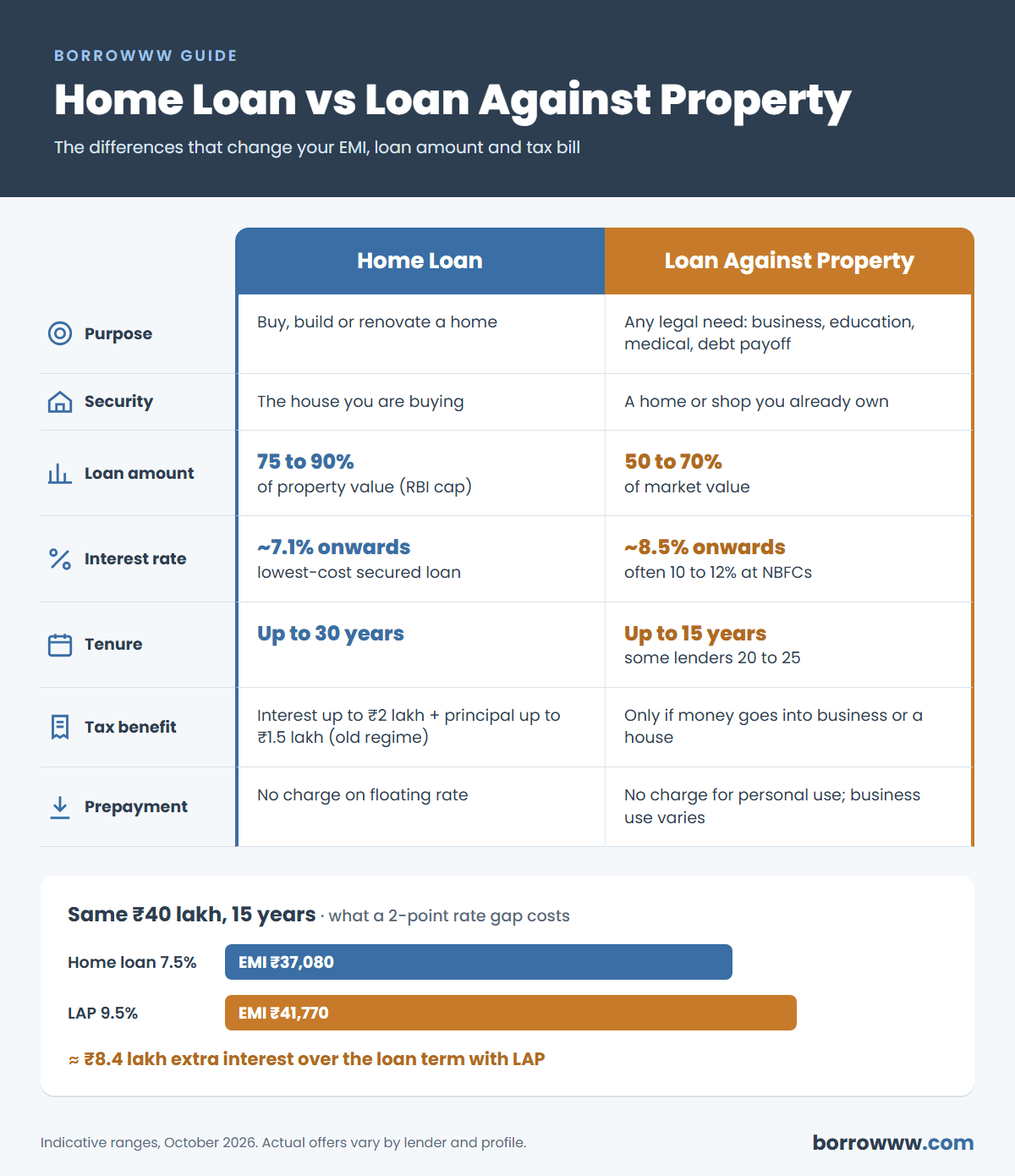
The table below sums up the difference between home loan and loan against property using rates seen in October 2026. Treat the numbers as ranges. Your actual offer depends on the lender, your credit score and the property.
| Point | Home Loan | Loan Against Property |
|---|---|---|
| Purpose | Buy, build, extend or renovate a home | Any legal personal or business need |
| Security | The house being bought | A residential or commercial property you already own |
| Where the money goes | Builder or seller | Your bank account |
| How much you can borrow | Up to 75 to 90% of property value (RBI cap, based on loan size) | Usually 50 to 70% of market value |
| Interest rate | Starts around 7.1 to 7.4% a year | Starts around 8.5 to 9.5%, often 10 to 12% at NBFCs |
| Maximum tenure | Up to 30 years | Usually up to 15 years, some lenders 20 to 25 |
| Tax benefit | Interest and principal deductions (old regime) | Only if the money goes into business or a house |
| Prepayment charge (floating rate) | Nil for individuals | Nil for personal use; business use depends on lender |
| Main approval factor | Income and credit score | Property value, title and income |
The Differences That Actually Change Your Decision
1. What you can spend the money on
A home loan is tied to one house. A LAP is not tied to anything, except that lenders will not fund speculation, like buying shares or gold. Expanding a factory, paying medical bills, funding a daughter’s master’s degree abroad, clearing a 36% credit card balance: all of these are fine.
2. How much you can borrow
RBI caps home loans at 90% of property value for loans up to ₹30 lakh, 80% between ₹30 and ₹75 lakh, and 75% above that. LAP has no such RBI slab, but lenders are stricter on their own, because they are lending against an asset for a purpose they cannot fully see.
Take a flat worth ₹80 lakh. As a purchase, a bank could fund up to ₹64 lakh of it. Pledge the same flat for a LAP and you might get ₹48 to 56 lakh.
3. Interest rate, and what it does to your EMI
This is where the difference between home loan and loan against property hits your pocket every month. The rate gap is usually 1.5 to 3 percentage points. On a ₹40 lakh loan over 15 years, here is what a 2-point gap looks like:
- Home loan at 7.5%: EMI of about ₹37,080, total interest about ₹26.7 lakh
- LAP at 9.5%: EMI of about ₹41,770, total interest about ₹35.2 lakh
That is ₹4,690 more every month and roughly ₹8.4 lakh more over the full term, for the same amount borrowed. Try your own figures on the EMI calculator.
4. Tax benefits under the new Income-tax Act
The Income-tax Act, 2025 came into force on 1 April 2026 and renumbered the familiar sections. Home loan interest, earlier claimed under Section 24(b), now sits under Section 22(1)(b), with the same ₹2 lakh cap for a self-occupied home. Principal repayment, the old 80C benefit, moved to Section 123 with the ₹1.5 lakh limit. Both are available only if you choose the old tax regime.
A LAP gets no automatic tax break, and many borrowers miss this part of the difference between home loan and loan against property. Interest becomes deductible only when the money goes into your business (as a business expense) or into buying or building a house. Use LAP money for a wedding and you get nothing back. Keep bank statements that show where the money went, because that trail is what your CA will need. For the details, see our guide on LAP tax benefits.
5. Prepayment charges
Short one. Under the RBI’s Pre-payment Charges on Loans Directions, 2025, lenders cannot charge you for prepaying a floating-rate loan taken as an individual for personal use, if it was sanctioned on or after 1 January 2026. That covers most home loans. A LAP taken for business is different, and depending on the lender a charge may still apply, so read the Key Facts Statement before you sign.
Which One Should You Pick?
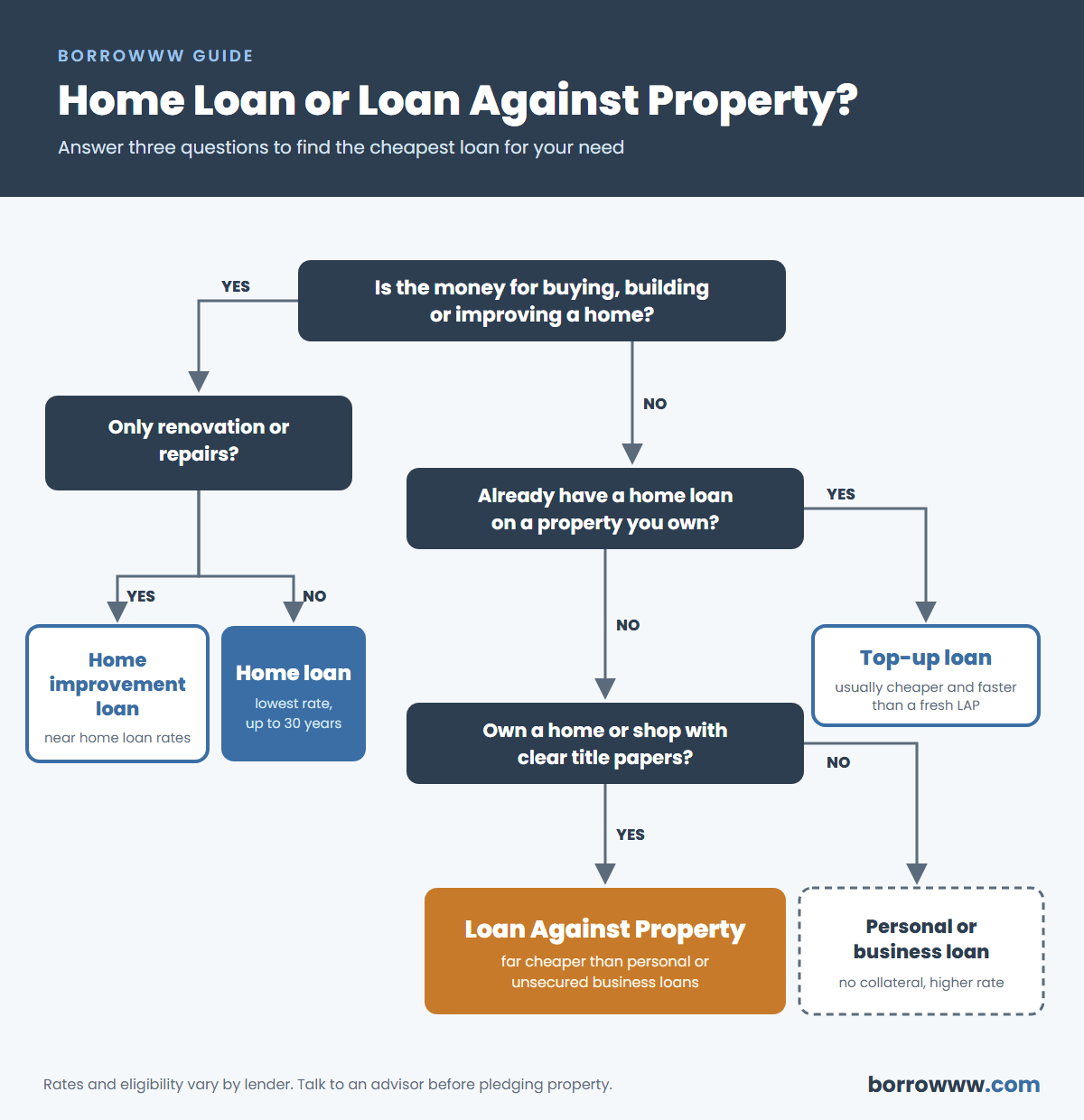
If you are buying or building a home, take a home loan. Every time. Some people take a LAP on a parent’s house to buy a flat because “the property is already there,” and they end up paying the higher rate on what should have been the cheapest loan they will ever get.
If you need money for a business, LAP usually beats the alternatives by a wide margin. Unsecured business loans and personal loans often cost 12 to 24%, so pledging property at 9 to 11% can halve your interest bill.
Two in-between options get overlooked when people weigh up the difference between home loan and loan against property. A home improvement loan is priced close to a home loan and works well for renovation. If you already have a home loan and need more money, a top-up loan from the same lender is usually cheaper and faster than a fresh LAP, because the property is already mortgaged and verified.
Three Mistakes Worth Avoiding
Pledging the only family home for a shaky business plan. If EMIs stop for 90 days, the account turns into a non-performing asset. Under the SARFAESI Act the lender can then send a 60-day notice and move to take possession without going to court. Plenty of borrowers do not realise how quickly that clock runs.
Comparing only the interest rate. LAP processing fees of 1 to 2%, plus legal and valuation charges, can add up to ₹50,000 or more on a large loan.
Ignoring the paperwork. LAP approval often stalls on a missing sale deed, an unapproved building plan or an old loan that was never formally closed. Check the LAP documents list before you apply. If you are buying, the home loan documents checklist covers what banks ask for.
Frequently Asked Questions
Is a loan against property cheaper than a personal loan?
Yes, in most cases. LAP rates usually start around 8.5 to 9.5%, while personal loans often run from about 10.5% up to 24% depending on your profile.
Can I take a loan against property on a house that still has a home loan?
Not from a new lender, since the house is already mortgaged. Your current lender may offer a top-up loan, or you can transfer the existing loan and take a top-up with the new bank.
Can I get a LAP on a property owned by my parents?
Yes, but every owner on the title has to join the loan as a co-applicant and sign the mortgage.
Still weighing up the difference between home loan and loan against property for your own situation? Start with what the money is for, then compare what each option costs over the full tenure. A Borrowww advisor can put real lender offers for your profile side by side, for both a home loan and a loan against property, before you commit your property to either one.